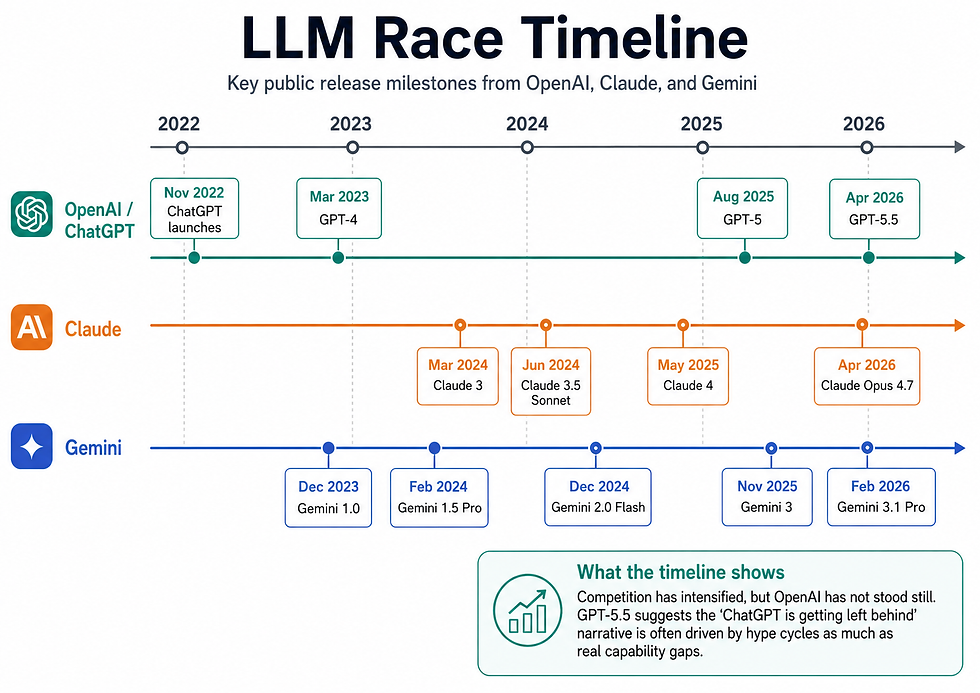
Does Claude Live Up to the Hype, or Is ChatGPT Still the Better Business Tool?

AI tools are now part of everyday business life. Small businesses are using them to write content, summarise documents, analyse data, plan campaigns, answer customer questions and speed up admin through better AI automation.
But with so much noise around AI, one question keeps coming up: is Claude actually better than ChatGPT, or is it just the latest tool getting attention?
The honest answer is that Claude does live up to a lot of the hype, especially for writing, document-heavy work and some coding tasks. But for most small businesses, ChatGPT is still the stronger all-round business tool. It has broader features, stronger integrations, better multimodal tools and a more complete workspace for day-to-day use.
That does not mean Claude should be ignored. In fact, the best answer for many businesses may not be “Claude or ChatGPT”. It may be knowing when to use each one.
Claude vs ChatGPT: the quick answer
Claude is excellent if you want thoughtful writing, long document analysis, careful summarisation and natural-sounding responses. It often feels less robotic and can be very good at interpreting context.
ChatGPT is better if you want one tool that can handle a wider range of business tasks. It can support planning, research, writing, file analysis, data work, image generation, process mapping and workflow development. So the simplest practical answer is this: Claude may be the better writer, but ChatGPT is usually the better business platform.
Why Claude is getting so much attention
Claude has built a strong reputation for quality. Many users prefer it for writing because the output can feel more natural, measured and less formulaic. For businesses creating blogs, proposals, reports, policy documents, email sequences or internal guidance, that matters.
Claude is also strong with longer documents. It is good at handling large amounts of context, spotting themes, summarising complex information and turning rough notes into something structured. This makes it useful for businesses that work with meeting transcripts, briefs, research documents, contracts, policies or technical information.
Anthropic has also pushed Claude further into business use with features such as projects, research, Claude Code, Microsoft 365, Slack and team administration. That makes Claude a serious business tool, not just a chatbot with nice writing.
Where Claude performs best
Claude performs particularly well when the task depends on judgement, tone, long-form thinking or careful interpretation of documents. For written content, it can produce clear, considered drafts that often need less editing to sound natural.
For long document work, it can pull out useful themes, risks, summaries and recommendations. For coding and technical support, it has become popular with developers and technically minded teams, especially where Claude Code is part of the workflow. This makes Claude useful for agencies, consultants, professional services firms, software teams and businesses that create a lot of written or technical material.
Where ChatGPT is still stronger
ChatGPT’s biggest advantage is breadth. For a small business, the best AI tool is not always the one that writes the nicest paragraph. It is the one that fits into everyday workflows and gets more jobs done without constant switching.
That is where ChatGPT still has a strong advantage. It is useful for general business planning, SEO research, content briefs, file analysis, spreadsheet work, image generation, voice conversations, custom GPTs, data analysis, research workflows and repeatable internal processes.
For many small businesses, ChatGPT feels more like an operating system for AI work. Claude feels more like a highly skilled specialist.
What about AI search and AEO?
This comparison also matters because AI tools are changing how people search for information. Small businesses should not only ask which AI tool they should use. They should also ask how they can make sure AI tools understand and recommend their business.
AI search is growing alongside Google rather than fully replacing it. For content, this means businesses need to think beyond traditional SEO and start building SEO and AI-optimised websites that both people and AI systems can understand. Clear sections, direct answers, question-led headings, concise definitions and entity-rich content all help.
This is where both Claude and ChatGPT can support a content workflow. Claude may be better at shaping the language. ChatGPT may be better at building the wider SEO and AEO process, including keyword research, content structure, schema, internal linking, data analysis and publishing support.
Is Claude better than ChatGPT for small business content?
For pure writing quality, Claude often has the edge. If you give both tools the same rough notes and ask for a human-sounding article, Claude may produce something warmer, calmer and more naturally structured.
But content quality is not just about the first draft. A strong business content process also needs research, keyword mapping, search intent analysis, internal linking, metadata, schema, content repurposing, social posts, image ideas and performance review. This is part of a wider shift in the AI services UK businesses are buying in 2026, where the real value is not just generating content, but making AI useful inside everyday business processes.
ChatGPT is usually stronger across that full workflow because it has broader built-in tools and better support for repeatable processes.
Is Claude better value than ChatGPT?
At the individual paid level, both Claude and ChatGPT have plans aimed at regular users, but value depends on what you need the tool to do. Claude may be better value if most of your work is writing, editing, document review or coding.
ChatGPT may be better value if you want one tool for content, data, images, research, automation support, customer service ideas, internal workflows and general business problem-solving. For many small businesses, ChatGPT gives more practical value because it covers more of the jobs they need doing.
The main drawbacks of Claude
Claude is not perfect. The first issue is usage limits. For heavy users, especially those doing coding, long document work or repeated uploads, this can become frustrating. Higher tiers are partly designed for people who need more capacity, which means the cost can rise as business use increases.
The second issue is ecosystem. Claude is improving quickly, especially with business integrations, but ChatGPT still feels more mature as a broad workspace for different types of tasks. Some of Claude’s best value also depends on how much you use its advanced features.
The main drawbacks of ChatGPT
ChatGPT’s weakness is that it can sometimes sound too polished, too generic or too confident. For brand writing, it often needs a stronger editorial steer. Without good prompting and good source material, the output can feel like AI content.
It can also be tempting to rely on ChatGPT because it does so much. That creates a different risk: businesses may use it for everything without checking whether it is the best tool for each job. Like Claude, ChatGPT also has plan differences and usage limits depending on how it is used.
So, does Claude live up to the hype?
Yes, mostly. Claude is not just hype. It is a genuinely strong AI assistant, particularly for writing, document work, coding and thoughtful analysis. If your business relies heavily on written communication, technical work or long-form documents, it is worth testing.
But ChatGPT is still the better default choice for most small businesses. It is broader, more flexible and more useful across the full range of day-to-day work. It is not always the best writer out of the box, but it is better as a central AI workspace.
The best way to think about it is simple: Claude is the specialist you bring in when the words, nuance or long document handling really matter. ChatGPT is the everyday business assistant that can help across strategy, content, research, data, images, automation and operations.
For most SMEs, start with ChatGPT. Add Claude if writing quality, long document work or technical workflows are important enough to justify using both.
Not sure which AI tool makes sense for your business? Speak to Glow AI and we can help you find the most practical setup for your team.
FAQs
Is Claude better than ChatGPT?
Claude can be better than ChatGPT for natural writing, long document analysis and careful summarisation. ChatGPT is usually better as an all-round business tool because it supports a wider range of tasks, including research, file analysis, image generation, data work, workflow planning and custom GPTs.
Is ChatGPT or Claude better for small businesses?
For most small businesses, ChatGPT is the better starting point because it is more versatile. It can help with marketing, admin, customer service ideas, content planning, data analysis and business strategy. Claude is still worth considering if your business creates a lot of written content, proposals, reports or long documents.
Is Claude better for writing than ChatGPT?
Claude often produces writing that feels more natural, calm and considered. It can be very strong for blogs, reports, proposals and editing. However, ChatGPT can still produce excellent writing when it is given a clear brief, brand tone, examples and source material.
Is ChatGPT better value than Claude?
ChatGPT is often better value for businesses that want one AI tool to handle lots of different jobs. Claude may be better value if your main use cases are writing, editing, long document review or coding. The right choice depends less on which tool is “best” and more on what you need it to do every week.
Should I use both Claude and ChatGPT?
Using both can make sense if you rely heavily on AI. A practical setup is to use ChatGPT for planning, research, SEO, data analysis and workflow support, then use Claude for writing, rewriting and reviewing longer documents. For many small businesses, though, starting with one tool is more cost-effective.
What is the best AI tool for business owners?
The best AI tool for business owners is the one that fits into their everyday workflow. ChatGPT is usually the strongest general option because it can support a broad range of business tasks. Claude is a strong specialist option for businesses that need high-quality written content, document handling or detailed analysis.
Can Claude and ChatGPT replace a human marketer or consultant?
No. Claude and ChatGPT can speed up research, planning, writing and analysis, but they still need human direction. The best results come when a person provides strategy, judgement, brand context and final review. AI is most useful as a productivity tool, not a full replacement for expertise.
Which AI tool should I start with?
Most small businesses should start with ChatGPT because it covers more use cases in one place. Once you know how AI fits into your business, you can test Claude for specific tasks such as blog writing, document summaries, proposals or technical work. That way, you only add extra tools when there is a clear benefit.