ChatGPT vs Claude vs Gemini: Which AI Tool Is Best for Small Businesses in 2026?

Executive summary
The short answer is no, but the reasons people think it is are not imaginary. As of 25 April 2026, the strongest evidence does not support the claim that ChatGPT has been decisively overtaken overall. OpenAI’s latest public flagship, GPT‑5.5, was officially announced on 23 April 2026 and rolled into the API on 24 April 2026. In the best current third-party composite ranking I found, it leads the field; and in OpenAI’s own public comparison tables it leads on several high-value agentic and knowledge-work tasks, including Terminal-Bench 2.0, GDPval, OSWorld-Verified, BrowseComp, OfficeQA Pro and FrontierMath. But that does not mean OpenAI has a clean sweep. Anthropic’s Claude Opus 4.7 still looks stronger on some developer-critical coding and reasoning tasks such as SWE-Bench Pro, FinanceAgent, MCP-Atlas, GPQA Diamond and Humanity’s Last Exam, while Google’s Gemini 3.1 Pro remains unusually strong on ARC-AGI-2 and offers the sharpest price/performance trade-off of the three on API pricing and throughput.
The deeper conclusion is that the frontier is no longer dominated by a single “best” model in the way public discourse often implies. Instead, leadership is fragmented by use case. If you care most about long-running autonomous coding and repo work, Anthropic still has a serious claim. If you care about Google-native multimodality, search grounding, enterprise Workspace integration, or lower API cost, Gemini is highly competitive. If you care about broad knowledge work, tool use, research, office tasks, and the most fully packaged consumer product surface, GPT‑5.5 and ChatGPT have reasserted themselves strongly. The phrase “left behind” therefore captures some mindshare drift, especially in coding circles, but overstates the capability picture.
A second reason perception diverges from the benchmark picture is that product experience and model experience are no longer the same thing. ChatGPT, Claude, and Gemini are not just model endpoints. They are increasingly bundles of agents, connectors, coding tools, deep-research workflows, enterprise controls, and subscription economics. OpenAI has benefited from breadth in ChatGPT, Codex, Responses API tools and connectors; Anthropic has built a very clear developer identity around Claude Code, Cowork, Design, and MCP; Google has leaned hard into native multimodality, Search grounding, Workspace, NotebookLM, Vertex AI and Antigravity. When users say one system is “ahead”, they often mean the total workflow, not a raw model score.
The benchmark war also needs stronger scepticism than marketing posts usually invite. Some of the most quoted numbers come from vendor-selected tables. Some leaderboards are live and dynamic. Some classic benchmarks, such as MMLU and HELM, are either saturated, inconsistently reported for the newest closed models, or difficult to compare cleanly in their current live implementations. On top of that, labs are converging on newer tests such as GPQA Diamond, Humanity’s Last Exam, FrontierMath, SWE-Bench Pro, OSWorld-Verified and GDPval, precisely because older broad-knowledge tests are less informative at the frontier. So the defensible judgement is not “ChatGPT is behind” or “ChatGPT is clearly ahead”. It is: OpenAI has materially recovered competitive leadership with GPT‑5.5, but the market is now specialised enough that any absolute verdict depends on which job you care about.
How the race changed
Recent releases explain much of the current mood. Anthropic’s cadence was especially strong for developers, moving from Claude 3.7 Sonnet to Claude 4, then Opus 4.5, 4.6 and 4.7, while also expanding Claude Code, Cowork and Xcode support. Google moved from Gemini 3 in November 2025 to Gemini 3.1 Pro in February 2026 and then broadened the surrounding product stack through AI Studio, Vertex AI, NotebookLM, Search and enterprise agent tooling. OpenAI launched GPT‑5 in August 2025, GPT‑5.4 in March 2026 and GPT‑5.5 in April 2026, while consolidating developer tooling around the Responses API and expanding ChatGPT’s connectors, deep research, Codex and agent mode. That fast, overlapping cadence is one reason perception can lag evidence by weeks or months.
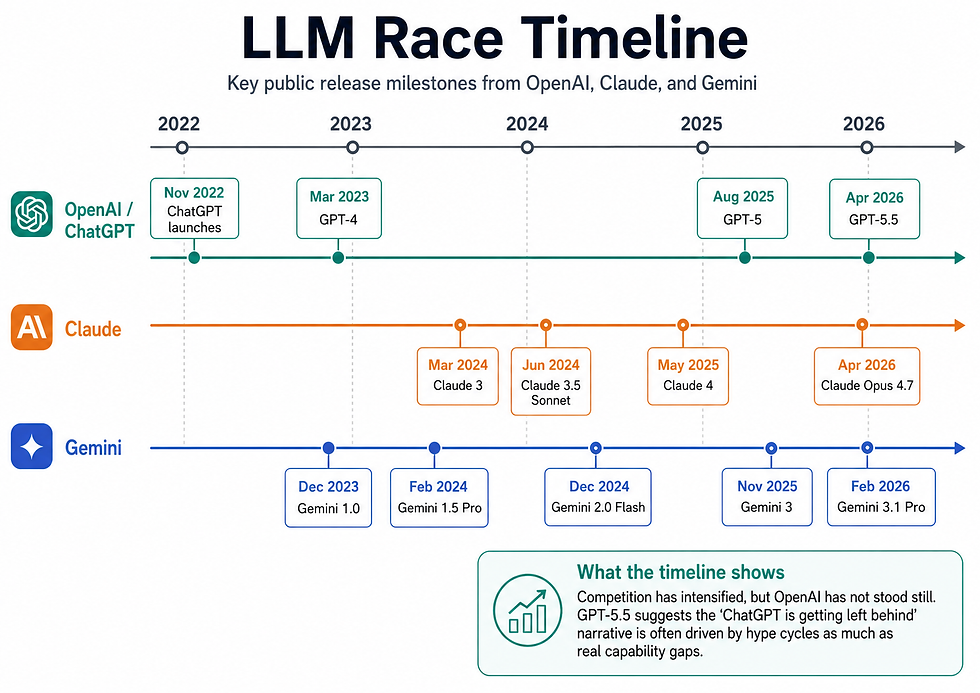
That timeline also shows why “left behind” became plausible as a narrative. Through late 2025 and early 2026, Anthropic built a reputation for coding quality and long-run agent reliability, and Google built a reputation for impressive reasoning-per-dollar and native multimodality. Meanwhile OpenAI’s line-up looked more confusing to many developers, with multiple GPT‑5.x and Codex variants, plus product and API distinctions that were not always obvious. Community discussion on Hacker News explicitly called this a “model mess” around GPT‑5.4, which helps explain how a real product-positioning problem can coexist with frontier-level underlying capability.
Vendor profiles
OpenAI
Publicly, GPT‑5.5 is framed less as a pure benchmark model than as a system for “real work”: coding, research, analysis, spreadsheets, documents and tool use. OpenAI’s GPT‑5 line is described as a unified system that routes between faster and deeper reasoning modes, but GPT‑5.5’s public docs do not disclose parameter counts or a detailed model architecture. The API model page lists roughly a 1M context window, 128K max output tokens, text-and-image input with text output, and reasoning-effort controls from none to xhigh. OpenAI has paired that with a broad product layer: ChatGPT plans that now highlight GPT‑5.5 Thinking, deep research, agent mode, projects, tasks, memory and custom GPTs; Codex for coding; Apps SDK support built around MCP; and an expanding connector set for both consumer and enterprise workspaces. OpenAI is also clearly consolidating around the Responses API, which can call built-in tools such as web search, file search and code execution, while the older Assistants API is now deprecated and scheduled to shut down on 26 August 2026.
OpenAI’s pricing picture is now split three ways: ChatGPT subscriptions, API usage, and business seats. For consumers, ChatGPT Plus remains $20 per month, while Pro is now split into a $100 and a $200 tier with differing usage allowances; Business standard seats are $25 per user per month on monthly billing or $20 on annual billing, with a two-seat minimum. On the API side, GPT‑5.5 is $5 per million input tokens and $30 per million output tokens, while GPT‑5.5 Pro is $30 and $180; OpenAI also offers Flex, Batch, and regional-processing options, with a 10 percent uplift on regional processing for supported GPT‑5.5 endpoints. On data controls, OpenAI states that API data is not used to train models unless the customer explicitly opts in.
Safety-wise, the GPT‑5.5 system card says the model’s performance on OpenAI’s challenging-prompt policy evaluations is broadly on par with GPT‑5.4-Thinking, and that most observed regressions were not statistically significant. OpenAI’s latest release also suggests a strategic shift from “best chatbot” to “best work platform”: more connectors in chat, more enterprise indexing, and tighter integration between ChatGPT, Codex and tool use. That breadth is one of the main reasons it is hard to argue that ChatGPT has been “left behind” as a product, even when competitors win particular benchmarks.
Anthropic
Anthropic’s latest generally available top-end model is Claude Opus 4.7. Anthropic’s own docs call it the company’s most capable generally available model and describe the Claude 4 family as hybrid reasoning models. The publicly available description of architecture is still high-level rather than structural: Anthropic emphasises hybrid reasoning, agentic coding, tool use, high-resolution vision and multi-hour autonomy, but does not publish parameter counts. Opus 4.7 has a 1M context window, text-and-image input with text output, and is distributed not only through Anthropic’s own API and consumer app, but also through Amazon Bedrock, Google Vertex AI and Microsoft Foundry. That multi-cloud distribution is a significant enterprise advantage.
Anthropic’s product identity is unusually coherent. Claude Code, Cowork, Xcode integration, and the company’s deep embrace of MCP have given Anthropic a strong developer brand. On the business side, Anthropic’s pricing page is explicit that Enterprise offers central billing, SSO, SCIM, audit logs, compliance API, HIPAA-ready options, data-retention controls, enterprise search, connector controls, and Google Docs cataloguing, with no training on enterprise content by default. Consumer plans include Free, Pro, Max, Team and Enterprise tiers, though exact consumer prices can vary by channel. API pricing for Opus 4.7 is $5 per million input tokens and $25 per million output tokens, with batch discounts and prompt caching. Anthropic also notes that Opus 4.7 uses a new tokenizer that can consume up to about 35 percent more tokens for the same fixed text, which matters when evaluating real cost.
On safety and guardrails, Anthropic’s messaging is more explicit than most rivals. The Opus 4.7 launch states that the model is “largely well-aligned and trustworthy, though not fully ideal”, shows low rates of concerning behaviour overall, improves on some honesty and prompt-injection measures, but is modestly weaker on certain controlled-substance harm-reduction cases. Anthropic’s trust-centre materials also show a willingness to discuss regressions, and its recent postmortem on prompt changes to Opus 4.7 and Sonnet 4.6 confirms that system-level changes can hurt coding performance and need rollback. That transparency is valuable, but it also underlines a broader point: benchmark leadership alone does not immunise a model against regressions in day-to-day product use.
Google’s latest broadly available premium general model is Gemini 3.1 Pro, released on 19 February 2026. Google describes Gemini 3.1 Pro as part of a “natively multimodal reasoning” family and its public model card says it is based on Gemini 3 Pro; as with the others, detailed architecture and parameter counts are not disclosed. What is disclosed is unusually strong input coverage: text, images, audio and video in, text out, with a 1M context window and 64K output tokens. Gemini 3.1 Pro is available across the Gemini app, AI Studio, Gemini API, Vertex AI, NotebookLM, Gemini Enterprise, and Google’s Antigravity agent-development platform. That breadth across both consumer and enterprise surfaces is a major strength.
Google’s API and tooling story is also distinctive. Gemini 3 supports Search grounding, URL Context, Code Execution, File Search, Function Calling and Structured Outputs, and Google’s docs explicitly allow these to be combined. The Gemini API pricing page lists Gemini 3.1 Pro at $2 per million input tokens and $12 per million output tokens below 200K context, rising to $4 and $18 above 200K. That is materially cheaper than GPT‑5.5 or Claude Opus 4.7 at standard rates. Google’s independent performance snapshot from Artificial Analysis also shows very high output throughput for Gemini 3.1 Pro, which reinforces its value-for-money case. On the product side, Google now bundles consumer access through Google AI Plus, Pro and Ultra plans, while Workspace and Cloud announcements position Gemini Enterprise around agent creation, search, scheduling, canvas/document workflows and Google-native integration.
Google’s notable weakness is customisation. The official Gemini API tuning page says there is currently no model available for fine-tuning in the Gemini API or AI Studio, though tuning is supported in Gemini Enterprise Agent Platform. Developer-forum discussions in March and April 2026 show demand for Gemini 3.x supervised fine-tuning and concern from teams migrating off older tuned Gemini 2.5 endpoints. In other words, Google is strong on model capability, grounding and platform integration, but weaker than OpenAI on broadly self-serve customisation, and arguably less mature than Anthropic in the day-to-day developer narrative around prompt discipline and coding ergonomics.
Model comparison snapshot
Dimension | GPT‑5.5 / ChatGPT | Claude Opus 4.7 / Claude | Gemini 3.1 Pro / Gemini |
Latest flagship release | GPT‑5.5 announced 23 Apr 2026; API release 24 Apr 2026 | Claude Opus 4.7 announced 16 Apr 2026 | Gemini 3.1 Pro announced 19 Feb 2026 |
Public architecture detail | Detailed architecture not disclosed; GPT‑5 family described as a routed/unified system | Hybrid reasoning model; detailed architecture not disclosed | Natively multimodal reasoning family; 3.1 Pro is based on Gemini 3 Pro |
Context window | About 1M | 1M | 1M / 64K out |
Modalities | Text + image input, text output at model level | Text + image input, text output | Text, image, audio, video input; text output |
Consumer access | ChatGPT Free, Go, Plus, Pro; Codex bundled increasingly into paid plans | Free, Pro, Max, Team, Enterprise | Google AI Plus, Pro, Ultra; Gemini app access through Google AI plans |
API pricing | GPT‑5.5: $5 in / $30 out; GPT‑5.5 Pro: $30 in / $180 out | Opus 4.7: $5 in / $25 out | 3.1 Pro: $2 in / $12 out under 200K, $4 / $18 above 200K |
Fine-tuning / customisation | Broad self-serve optimisation stack: SFT, DPO, RFT, vision fine-tuning | Public emphasis is prompt engineering, MCP, skills, caching and enterprise customisation more than self-serve weight tuning | No current fine-tuning in Gemini API or AI Studio; tuning available in enterprise platform |
Tooling and extensions | Responses API tools, remote MCP servers, Apps SDK, connectors, custom GPTs, Codex | MCP, Claude Code, Cowork, Design, multi-cloud deployment | Grounding with Search, URL Context, Code Execution, File Search, Function Calling, Antigravity, Vertex AI |
Enterprise offering | Business and Enterprise seats, connectors, RBAC, indexed enterprise content, regional processing for API | Enterprise search, connector controls, audit/compliance stack, HIPAA-ready, no training on content by default | Gemini Enterprise, Workspace integration, Vertex AI, Agent Designer and enterprise-grounding stack |
Speed / latency snapshot | AA: 73 t/s, 64.21s TTFT for xhigh setting | AA: 46 t/s, 16.98s TTFT for max | AA: 127 t/s, 26.15s TTFT |
Benchmarks and independent evaluations
The highest-confidence benchmark picture comes from combining official release tables with independent leaderboards, not from relying on any one vendor. The cleanest independent summary I found is from Artificial Analysis. Its live leaderboard currently places GPT‑5.5 first on its Intelligence Index at 60, with Claude Opus 4.7 and Gemini 3.1 Pro both at 57. Artificial Analysis had previously described Opus 4.7, Gemini 3.1 Pro and GPT‑5.4 as effectively tied within its confidence interval; GPT‑5.5 breaks that tie in its current reporting. That matters because it suggests OpenAI has regained the top spot on a broad multi-benchmark composite, even if it does not dominate benchmark-by-benchmark.
At the same time, benchmark-by-benchmark results remain highly task-dependent. OpenAI’s own GPT‑5.5 launch page shows Claude Opus 4.7 ahead on SWE-Bench Pro, FinanceAgent, MCP Atlas, and narrowly on GPQA Diamond and Humanity’s Last Exam. Google’s Gemini 3.1 Pro page shows very strong academic-reasoning results, especially on ARC-AGI-2 and GPQA Diamond. Anthropic’s release messaging for Opus 4.7 stresses sustained coding, high-resolution vision, memory, instruction-following and long-horizon autonomy. Read together, those sources do not support a single-frontier story. They support a segmented one.
Benchmark comparison table
Benchmark | GPT‑5.5 | Claude Opus 4.7 | Gemini 3.1 Pro | Test date / source | Caveats |
Artificial Analysis Intelligence Index | 60 | 57 | 57 | 23-24 Apr 2026, Artificial Analysis live leaderboard | Composite benchmark, not a single eval; independent but methodology-weighted. |
SWE-Bench Pro (public) | 58.6% | 64.3% | 54.2% | OpenAI GPT‑5.5 launch table, 23 Apr 2026 | Same-table vendor comparison, but still vendor-published; OpenAI itself notes memorisation concerns on this family of evals. |
GDPval wins or ties | 84.9% | 80.3% | 67.3% | OpenAI GPT‑5.5 launch table, 23 Apr 2026 | Vendor-published comparison; GDPval is newer and more work-like than classic knowledge tests. |
OSWorld-Verified | 78.7% | 78.0% | Not published in same table | OpenAI GPT‑5.5 launch table, 23 Apr 2026 | Tool-use scaffolding matters a lot; missing Gemini number in the published same-table comparison. |
BrowseComp | 84.4% | 79.3% | 85.9% | OpenAI GPT‑5.5 launch table, 23 Apr 2026 | Browsing evaluations are sensitive to blacklist and cheating-detection pipelines. |
GPQA Diamond | 93.6% | 94.2% | 94.3% | OpenAI GPT‑5.5 table and Google Gemini 3.1 page | Very close scores; configurations are vendor-selected and not guaranteed to be like-for-like. |
Humanity’s Last Exam, no tools | 41.4% | 46.9% | 44.4% | OpenAI GPT‑5.5 table and Google Gemini 3.1 page | Another close frontier eval where tool policy and prompt setup matter. |
FrontierMath tier 1-3 | 51.7% | 43.8% | 36.9% | OpenAI GPT‑5.5 table, 23 Apr 2026 | Vendor-published same-table comparison. |
ARC-AGI-2 | No robust comparable current official score found | No robust comparable current official score found | 77.1% | Google Gemini 3.1 Pro page; ARC Prize leaderboard notes major preview/provisional caveats | ARC data are live and sometimes provisional; direct head-to-head across the newest public closed models remains messy. |
Two classic benchmark families deserve explicit treatment because they are often cited in public debates but are less useful here than people assume. First, MMLU: I could not find a consistent, current, official 2026 MMLU or MMLU-Pro figure for all three latest public flagships in their current release materials. That is itself informative. Vendors now highlight GPQA Diamond, Humanity’s Last Exam, FrontierMath, SWE-Bench, OSWorld and GDPval more heavily, which strongly suggests that classic MMLU is no longer the main frontier discriminator. Second, HELM: Stanford’s HELM remains an important framework and live leaderboard, but I could not retrieve a clean, parseable head-to-head entry set for GPT‑5.5, Claude Opus 4.7 and Gemini 3.1 Pro in this session, so I am treating HELM as a framework reference rather than a numeric row in this comparison.
That benchmark pattern yields an analytically cleaner conclusion than social media usually does. If your question is “who is best at broad, commercially valuable, tool-using work right now?”, the best evidence points to GPT‑5.5. If your question is “who is best at serious repo-level coding and long-running engineering workflows?”, Claude Opus 4.7 remains highly credible and sometimes stronger. If your question is “who gives the strongest reasoning and multimodality per pound spent?”, Gemini 3.1 Pro is hard to ignore. So benchmark evidence weakens the thesis that ChatGPT is simply “behind”. What it really shows is three different ways to lead.
Independent commentary and market sentiment
Across Hacker News, Reddit, and X, sentiment looks active, divided, and highly use-case-specific rather than unanimous. That matters because “ChatGPT is falling behind” is often a sentiment claim before it is a technical one. The available public evidence suggests three overlapping narratives: Claude has had the strongest coding mindshare; Gemini has become the “surprisingly good and surprisingly affordable” outsider; and ChatGPT has kept the broadest mainstream footprint but has sometimes suffered from lineup confusion and pricing frustration.
What the public discussion sample looks like
Platform | Public discussions surfaced | Quantifiable engagement | Dominant themes |
Hacker News | Gemini 3.1 Pro launch, Claude Opus 4.7 model card, GPT‑5.5 API release | Gemini 3.1 Pro: 963 points / 914 comments; Claude Opus 4.7 model card: 176 / 84; GPT‑5.5 API release: 223 / 124 | Gemini drew the biggest launch curiosity; Claude generated serious coding discussion; GPT‑5.5 discussion focused on pricing, rollout and whether the gains felt real in practice |
Claude Opus 4.7 announcement, Gemini 3.1 Pro experience thread, GPT‑5.5 experience threads | Claude announcement: 3.3K votes / 819 comments; Gemini 3.1 Pro thread: 796 votes / 161 comments; GPT‑5.5 threads visible but engagement not always exposed in search snippets | Claude has very strong enthusiast engagement; Gemini sentiment was early-positive on instruction following but also complaint-heavy around limits; GPT‑5.5 reactions split between “faster and better” and “feels incremental” | |
X | Official vendor launch posts surfaced cleanly, but engagement counts were not reliably exposed in accessible web output | No reliable cross-post metrics collected in this session | X is useful for qualitative reaction and vendor messaging, but not for robust comparable engagement counts here |
Qualitatively, the developer commentary is telling. On Hacker News, Gemini 3.1 Pro drew both deep enthusiasm and blunt criticism, with users praising large-context improvements while others complained about coding quality or rate limits. Claude Opus 4.7 discussions mixed praise for literal instruction-following and agentic coding with complaints about writing regressions and token burn. GPT‑5.5 discussions show a similar split: some users reported that the speed jump was a “game changer”, while others said it felt like GPT‑5.4 with a new label. That is exactly what you would expect when the top models are close enough that differences show up more in workflow fit than in obvious one-shot superiority.
There is also a gap between independent-expert commentary and casual social commentary. Artificial Analysis had Opus 4.7, Gemini 3.1 Pro and GPT‑5.4 effectively tied before GPT‑5.5; after GPT‑5.5, it moved OpenAI into first place on its composite. Simon Willison, who tends to be careful rather than breathless, described GPT‑5.5 as fast, effective and highly capable, while also drawing attention to practical API and prompting details rather than treating it as magic. That is a more sober reading than either “OpenAI is back forever” or “ChatGPT is over”.
Safety, enterprise, customisation, and product trade-offs
If you look beyond benchmark tables, each vendor is making a different strategic bet. OpenAI appears to be betting on the broadest integrated work platform: ChatGPT plus Codex plus Responses API tools plus connectors plus enterprise indexing and agent mode. Anthropic is betting on being the most trusted serious workstation for engineers and analysts, with a strong multi-cloud posture and a very explicit alignment-and-safeguards story. Google is betting on being the most native multimodal platform inside a giant existing ecosystem, tightly tied to Search, Workspace, Cloud and notebook/research workflows. Those are different competitive positions, and they matter at least as much as a two-point gap on a single benchmark.
On fine-tuning and customisation, OpenAI currently looks the most complete in broadly self-serve public tooling. Its docs prominently expose supervised fine-tuning, vision fine-tuning, DPO and RFT. Anthropic’s publicly emphasised customisation path is less about self-serve weight tuning and more about prompt engineering, tool use, prompt caching, MCP and enterprise-tailored deployments. Google’s position is the opposite of its broad platform strength: despite a very advanced tool stack, the Gemini API currently does not support fine-tuning, and Google explicitly says that tuning support is not currently available in Gemini API or AI Studio, though it exists in Gemini Enterprise Agent Platform. For orgs that rely heavily on tuned models, that is a real commercial trade-off.
On multimodality, Google currently has the clearest model-level advantage in public documentation. Gemini 3.1 Pro takes text, images, audio and video natively. GPT‑5.5’s API model page supports text and image input, but not audio or video at the model level, even though OpenAI has separate realtime and audio models and a very strong image stack elsewhere in the product line. Anthropic’s current flagship models support text and image input with strong vision, but not the same breadth of native modality as Gemini 3.1 Pro. So if “best LLM” in your context means “best single multimodal endpoint”, Google has the cleaner claim.
On latency and cost, Google has the strongest headline value proposition, Anthropic sits in the middle, and GPT‑5.5 is the most expensive of the three on standard public flagship API pricing. Artificial Analysis’ live snapshot also suggests Gemini 3.1 Pro is much faster in token throughput than Claude Opus 4.7 or GPT‑5.5 xhigh, while GPT‑5.5’s strongest reasoning setting has the longest delay to first answer token. But speed metrics must be read carefully: reasoning-heavy OpenAI modes intentionally spend more time thinking first, and throughput numbers do not capture answer quality. In practice, there is still no free lunch. Gemini often gives the cheapest strong result, Claude often gives the coding-centric result many teams want, and GPT‑5.5 often gives the broadest high-end result if you are willing to pay for it.
On safety and regressions, none of these systems is close to solved. OpenAI’s own GPT‑5.5 system card says policy-performance regressions versus GPT‑5.4-Thinking were mostly not statistically significant, but it is still a reminder that gains in capability can arrive alongside brittle behaviour changes. Anthropic’s documents describe Opus 4.7 as largely trustworthy but not fully ideal, and its recent postmortem shows how prompt changes can accidentally degrade coding performance. Google’s model cards are clearer than average about intended use, limitations and multimodal risks, but Gemini also has visible forum complaints about long-context realism and rate-limit frustrations. So the main safety trade-off today is not just “more guardrails versus fewer guardrails”. It is also “more capability versus more variance”, and “more integration versus more surface area for regressions or misuse”.
Verdict
The evidence does not support the blanket claim that ChatGPT is being left behind by Claude and Gemini. GPT‑5.5 has materially strengthened OpenAI’s position and, on the best combination of official and independent evidence available today, OpenAI is back in front on the broadest “general professional work plus agents” framing. That is especially true if you combine model capability with product breadth.
But the evidence also does not support the opposite blanket claim that OpenAI has clearly re-established uncontested dominance. Anthropic still looks exceptionally strong in coding-intensive, long-running, tool-heavy engineering contexts, and it has unusually strong developer mindshare to match. Google still looks strongest on native multimodality and price/performance, and Gemini 3.1 Pro’s reasoning profile is strong enough that dismissing it as a third-place model would be analytically wrong. In other words, ChatGPT is not behind, but neither is it uniquely ahead in all the ways that matter.
My conditional verdict is:
For broad knowledge work, research, office tasks, computer use, and integrated consumer workflow: ChatGPT with GPT‑5.5 currently has the strongest case.
For serious coding and autonomous engineering workflows: Claude Opus 4.7 remains at least co-leading, and in some benchmarks still superior.
For multimodality, Google-native integration, and price/performance: Gemini 3.1 Pro remains one of the best buys on the frontier.
So is the concern “mostly hype”? Partly. The strongest hype component is the idea that one week of announcement momentum, one favourite coding model, or one benchmark screenshot proves that ChatGPT has been left behind. The non-hype component is that OpenAI did lose some narrative ground in developer circles, partly because Anthropic shipped a clearer coding story and Google shipped a more aggressive value story. GPT‑5.5 narrows or reverses much of that. The real story in April 2026 is not decline. It is specialisation, convergence, and fierce fragmentation at the top.
Open questions and limitations
This report prioritised official release materials, model cards, API docs, plan pages, live leaderboards and a small number of widely read public discussions. There are still important gaps. The newest public docs do not give a clean common set of MMLU scores for all three latest flagships; HELM is important as a framework but did not surface a clean parseable head-to-head for these exact models in this session; some live benchmarks such as ARC Prize explicitly flag preview or provisional results; and social-media sentiment is inherently biased by platform culture, ranking algorithms and the limits of public search snippets. Prices, plan entitlements and rollout status also change quickly. Those caveats do not overturn the main conclusion, but they do limit any claim of finality.

